
The life of Levar “City” Dale East Coast King Pin


On Labor Day 1999, LeVar Dale’s father threw a barbecue for his son and his friends. It was a beautiful day, the kind LeVar should have remembered for the people who came over and the time they spent together. Instead, his father suffered a fatal heart attack at the gathering. LeVar was fifteen. He still had school to go back to, but helping his mother pay the bills had suddenly become more important than anything happening in the classroom.
LeVar was born on June 6, 1984, on Long Island, New York. His father worked as a janitor in the New York City school system. His mother sold Mary Kay, raised the children at home, and also worked as an elementary school aide. LeVar was the youngest in a middle-class household. His brother was six years older, and a cousin who grew up with them was the middle child.
His early years coincided with the golden age of New York hip-hop. He saw how differently people could live depending on what they had, and he formed an opinion about money early. “I didn’t want to be poor or someone who waited for a handout,” he says. “I wanted to live a life that didn’t require watching every dollar.”
When LeVar was seven, his family moved to Florida to escape the cold because of his father’s health. In Orlando, the gaps between people with money and people without it became even more visible to him. He wanted the freedom he believed money could buy. He started by selling watches, cutting hair, mowing lawns, and washing cars to buy his school clothes.
He had two other ambitions. He wanted to play basketball and rap, and Shaquille O’Neal had shown him that somebody could do both. LeVar made his high school freshman team as a point guard. By sophomore year, after his father died, he was washing dishes for a paycheck and selling weed to friends. He kept his grades up, but his attention had shifted to earning money. Moving back and forth between two high schools gave him friends on both ends of east Orlando. Those relationships would later help him build a drug business.
LeVar and two close friends started hanging out with a crew called Bad News. They stole from liquor stores and got into trouble as they tried to make a name for themselves. LeVar treated the thefts like a business. He became known as one of east Orlando’s top boosters, returning stolen merchandise for cash. One of his biggest customers, an older Jamaican weed dealer, gave him lists of liquor he wanted and traded weed for what LeVar brought him. By seventeen, LeVar had a car, a steady weed business, and a nickname that followed him around east Orlando. People called him VarCity. He eventually shortened it to City.
When he moved into Stonewall Jackson, a neighborhood with an active drug trade, his operation grew. He started selling cocaine and other drugs, drawing on the relationships he had built on both ends of town. Before he turned twenty, he says, he was the biggest dealer on the east side of Orlando.
A knee condition called Osgood-Schlatter disease ended his basketball ambitions, but he kept rapping. In 2003, his group, The HoodStars, signed an independent deal. He traveled and performed with the group while continuing to run his drug business, which he estimates was bringing in about $1 million a year.
City had spent time in juvenile custody, but he says his first serious charge came at nineteen after a shootout in front of his trap spot. Police raided the property, forcing him to shut down and regroup. While avoiding arrest, he returned to armed robbery, something he says he never liked doing. He was eventually caught and spent time in county jail. By twenty-one, he was back on the street, selling cocaine by the kilo for a Puerto Rican cartel. He puts his annual earnings during that period between $3 million and $7 million. He says he never killed anyone, though he used armed robbery to retaliate against rivals.
That run lasted about five years. A break-in cost him more than $250,000 in drugs and jewelry. Then a middleman was conned out of a kilo of cocaine. When City’s right-hand man was robbed, shot, and later began cooperating with authorities, City stepped away. He lived on his savings for a few years, got back to making music, and began studying astrology and numerology. In his telling, the time away may also have kept him out of the cases that caught up with some of the people he had worked with.
In 2010, after serving eight months in county jail for fleeing and eluding, City went back into business selling synthetic drugs. He describes himself as an early player in that trade. He drove expensive cars, lived in luxury apartments and homes, and regularly spent thousands of dollars at strip clubs. His business expanded from Florida into West Virginia, Maryland, Richmond, Atlanta, and New York. “Wherever they were selling top dollar, I was there with it,” he says. It was the most money he had ever made. Then federal authorities began cracking down on Florida’s pill mills, and the run was short-lived.
City and his partners talked about hiring a scientist and pressing their own tablets, but before the plan got underway, he was drawn into a racketeering case involving a former cocaine customer. After seeing his face on the news, City spent a year on the run. U.S. marshals eventually caught him in Atlanta. By then, he says, the larger case had closed and the charges against him were reduced because of a lack of evidence. He spent two years in prison.
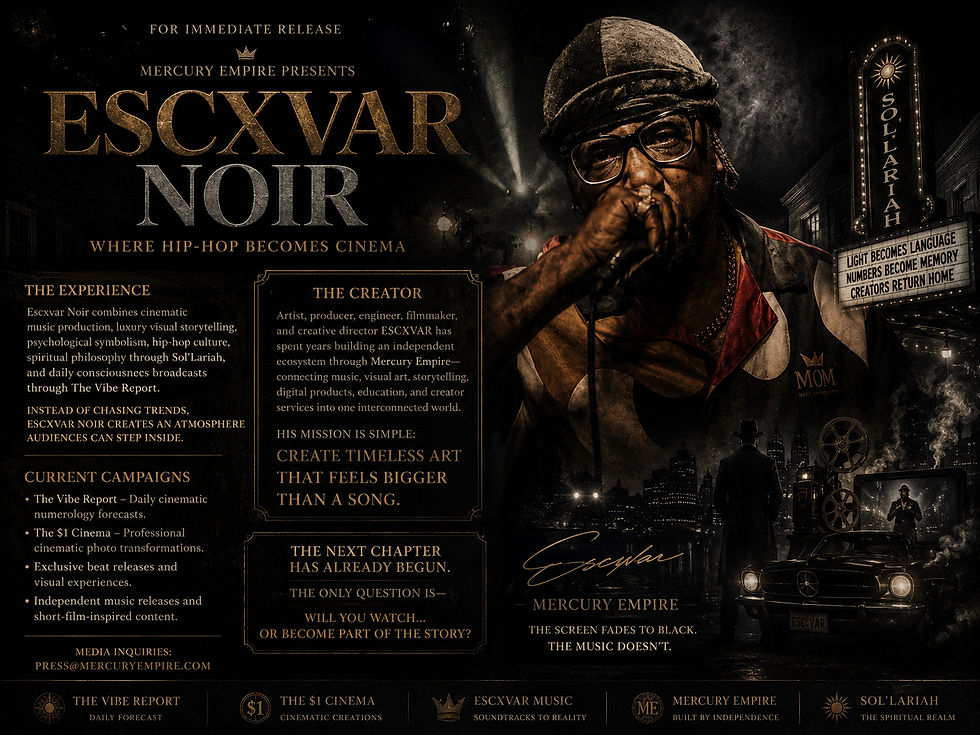
City traces the beginnings of ESCXVAR to that time in prison. After his release, he put his energy into music and taught himself to produce, record, mix, master, and market his own work. He had been rapping since his days with The HoodStars. Now he could make a record from the beat up and put it out himself.
As ESCXVAR, he makes street records from the life he lived as City. He can rap about the money and what it bought because he remembers wanting that freedom as a kid. He can rap about what it cost because he remembers seeing his face on the news and knowing he had to run. Both parts of the story are his to tell.


Comments